Sunday, March 10, 2013

Charles Burchfield

I first learned about Charles Burchfield at a rare painting/photography exhibition at the Fraenkel Gallery last September. In these paintings, nature has an intelligence and agency all its own: it twitches, sways and hums. Like the Group of Seven (see preceding post), Burchfield uses painting to enhance his spiritual connection to nature. As the title of the work pictured below suggests, it is God that inhabits every forest and field, animating them. Burchfield not only depicts landscapes aflame with bright, verdant beauty, but forceful, chaotic scenes as well. There is appeal in the power of nature and its ability to promote growth or destruction.

Charles Burchfield, Glory to God, 1949
Charles Burchfield, Glory of Spring (Radiant Spring), 1950
Charles Burchfield, North Wind in March, 1960
Charles Burchfield, Dandelion Seeds Heads and the Moon, 1961-1965
Charles Burchfield, Night Scene, 1935
Charles Burchfield, An April Mood, 1946-1955

Landscape Mega Post

Swedish artist, Marcus Ivarsson used an old encyclopedia as inspiration for these landscapes. The archaic monuments/volcanic forms are reminiscent of the clay miniature works of Charles Simonds.

Marcus Ivarsson, Hills album art, 2011

Marcus Ivarsson, Hills album art, 2011
Marcus Ivarsson, Hills album art, 2011
Marcus Ivarsson, Hills album art, 2011
I have been reading Hundreds and Thousands, the journal of painter and Canadian legend, Emily Carr. In her writings, Carr gives detailed descriptions of her travels, the quality of the clouds and air, and the work of other painters in her circle, particularly that of the Group of Seven (not to be confused with the Indian Group of Seven). She described these men as having creating "a world stripped of earthiness, shorn of fretting details, purged, purified; a naked soul, pure and unashamed. . . "(Carr, Emily. Hundreds and Thousands: The Journals of an Artist. Toronto: Irwin Publishing. 1966).

A. Y. Jackson, Hills at Great Bear Lake, 1953
Frank Johnston, The Fire Marshall, 1920
Franklin Carmichael, A Northern Silver Mine, 1930
Frank Johnston, Patterned Hillside, 1918
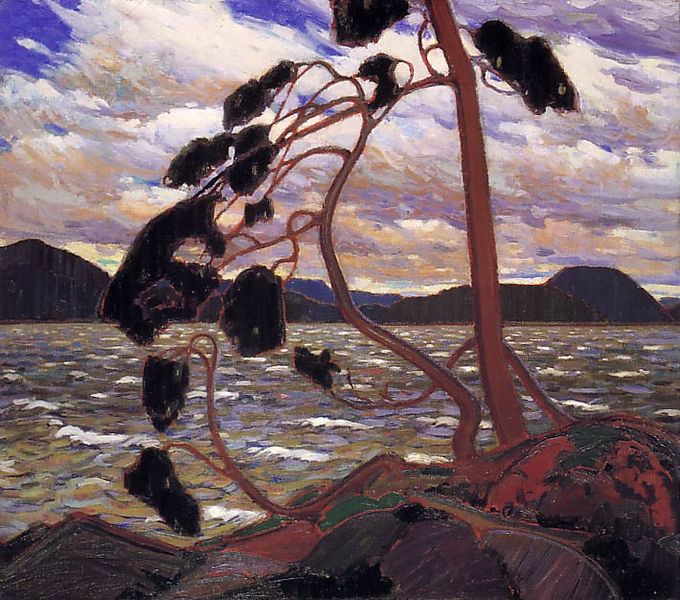
Tom Thomson, The West Wind, 1917
Franklin Carmichael, Bisset Farm, 1933
Lawren Harris, Icebergs, Davis Strait, 1930
Lawren Harris, Afternoon Sun, Lake Superior, 1924
Lawren Harris, Algoma Hill, 1920
Lawren Harris, Mount Robson from the North-East, 1929
Lawren Harris, Mount Thule, Bylot Island, 1930


While the Group of Seven was busy celebrating the pristine natural glory of their homeland, the majority of Llyn Foulkes' art focuses on its demise and destruction. There is no doubt we are in a different era. The works pictured below do not depict Los Angeles as a burning valley of trash, but they are distinctly barren and dead.

Llyn Foulkes, Post Card, 1964
Llyn Foulkes, Ghost Hill, 1984 
Llyn Foulkes, Rabyn's Rock, 1984
Llyn Foulkes, Top of Topanga, 1984

A couple of sculptures by Sam Richardson.

Sam Richardson, There's and Extended Cloud Over that Mountain, 1969
Sam Richardson, That's a Small Island with Snow and Frozen Water, circa 1970-1975

Monday, February 25, 2013

Mars Rocks

 Photo credit: Garry Hayes, Death Valley, CA

Desert landscapes have so much to say about color. Isolated from a variety of distracting elements, all that is recognizable are repeating color relationships. You can look at a hillside, and all you see are endless clusters of red, green and yellow. 

Photo credit: Mike Green, Ubehebe Crater, Death Valley, CA

Lynn Radeka, Black Rocks, Death Valley, CA, 1978.

The surface of Mars

Still Lives


Irving Penn, Still Life with Onion Skin, N.Y., 1947

Irving Penn, Still Life with Grape and Moth, N.Y., 1976

Irving Penn, 18 Pieces with Medicine Bottle, N.Y., 1980

These still lives do not assume an audience. The compositions are balanced, simple and make you feel like you've just come across a little marking of someone. I sense the same presence in this floor mosaic. A childlike process, meant only for personal amusement. 


Herakleitos, after a work by Sosos, Asaroton (Unswept Floor); 2nd century CE


Tuesday, August 23, 2011

I see these shapes


Drawing things from my head is hard. Not working from life, especially in painting, I struggle to create space.
The freedom to put shapes down on paper. Completely flat so I settle on their composition, balance of color, then proceed with what they do. How they are inside, what’s on the outside. How it exists in space. It takes awhile.
I am trying to to change the way I put charcoal on paper through each series. To keep the refinement structural. But this does not always work. I know I’m approaching the final row. That I need to bring the idea to some sort of completion.
But I never seek completion. I start a new set. This is the story of my life.


Thursday, August 18, 2011

Fighting by myself


I was looking at prostheses, and thinking of them as independent , mimicking the body, but being separate, a non-connected extension. They should have some more agency. Rather than moving them myself, I was looking for motion, energy by nature (sun, wind, water, gravity).


I have started playing with foam, and then memory foam. Twisting it into shapes, securing it with wire. The results just sat there. Stable, dead. But they did possess the memory of motion.


By manipulating the foam with some force to push it through metal frames, or make it bend upon itself in a certain way, I became more aware my force. Compressing the foam and quickly wrapping wire to get the right points of contact.

I fought the foam. It’s life was in its tension. I gave it life by contraction, and then when I release it inevitably blossomed.

Tuesday, August 16, 2011

reader's digest

Thinking about doing a storefront installation in a bookstore has gotten me thinking more about how the body is involved in ideas and language. When you read, you recite and internalize someone elses written words. You take in their mind. You become a vessel, clear your own internal narrative for a certain span of time. You ingest their statements and then choose to accept and adopt or reject.

I see a tongue licking a brain. To let a foreigner in and take them in at the same time. A reader digests.


Wednesday, August 10, 2011

Inside Out


On where you are: you become more critical if youre a stranger, you keep a distance.
To respond to the givens. Maybe you question the givens more if you approach a situation, as an alien, as a stranger. You are the alien witnessing a given. To you the strange situation sticks out from everything else, and focuses your attention.
See your body as a given. Your tool, your first toy, your container. I have always been infatuated with my body. The smell of my arms, the soft touch of my hair against my lips, the millions of times I have looked down at my hands splayed out, just to view them, admire them. But there is always the chance moment, not all the time, but say, when aside from looking at your hands, admiring them, picking out a piece of junk here or there, you notice them. You look at them and feel disconnected. They are strange. While, my sister always told me I had alien fingers, I don’t think this is the point. This feeling can come from looking at a tree or a toilet, both familiar and foreign (depending on how you feel), but again nothing as real to yourself as you.
Hygeinic ritual is a tried and true portal to disconnecting from one’s body. The focused attention of scraping, plucking, pressing and dragging sharp razors all over skin, relies on the sturdy build of the body (you usually don’t worry that if popping a pimple on your forehead will allow your brain to leak out) but also a fantastic test. The imminent, self inflicted danger can be thrilling and satisfying. Mammals soft, warm, and pulsing amidst steady violent tides that could thrash us into rocks. Most people remove themselves from the threat of the natural world only to test themselves in the bathroom, or maybe while driving.


Sunday, July 17, 2011

free beauties

"None of the objects, prayers and spirits invoked by the magician are what cause his spells to work. In fact, the magician himself is not the cause of the magic. Rather, magic is the cause of the magician. Because magic wants to happen, it will cause, or call, a body to act the role of magician." (Collective Experience and the Magic World View; Brian Kubarycz)

Polish paper sculptures hung at Christmas time that depict the universe

New working structure: Imagine the artist as a magician, channeling inspiration from outside source, universal will. I am aware of the connections, the forcing pushing me in certain directions, towards certain stories, songs, images when I am available to receive them. I need to keep an open mental space to be ready to receive these suggestions. Sometimes the problem though is overflow. I become overwhelmed by all the connections. Instead, identify and explore and act on them as they come. This is also supported by the fact that when I approach work, forcing ideas to spill out of my head, I find it empty. I am empty. It comes from the outside when it will.

Wednesday, July 13, 2011

my own first mouth toy

Babies get to know things with their mouths. Inside the womb, the only thing the fetus can put in its mouth are its own fingers ["a child's body is the first toy"]. How early do humans get feeling in their fingers? Through sucking and physical sensation, do they know they are sucking themselves? Through sucking and not feelings, do they know they are sucking something other than themselves?

In Purity and Danger, Mary Douglas remarks Sartre’s essay on stickiness. Honey has the power to show the distinction between “the subjective experiencing self and the experienced world”-how viscous, sticky substances “attack the boundary between myself and it”


"The child eventually moves from its own fingers to nipple, then to spoon or cup...chewing gum, smoking cigarettes, crunching hard candy, chewing the end of pencil/pen".